Housebuilders across Great Britain will need to think of new strategies and embrace new ways of working to bypass the increasing water scarcity. BuildSafe, leading insurer for housebuilders, has analysed the number of live new-build sites across Britain. From the 1,178 active sites, 915 are in drought areas, with 198 operating in prolonged dry weather locations.
Britain’s housebuilders have faced a tough year with a slow housing market and the driest summer months since records began. The Met Office declared that 72% of the UK is in drought, with over two-thirds of the population under water restrictions and extended hosepipe bans in August 2026.
Long before a residential development welcomes its first occupants, the construction phase places a substantial strain on local water supplies. To facilitate necessary site utility connections, housebuilders must account for an estimated 15,000 to 30,000 litres of water for every dwelling constructed.
Defra has also warned that failing to address water scarcity could result in more than 61,000 houses being put at risk of not being built under their assessed scenario.
The most affected areas
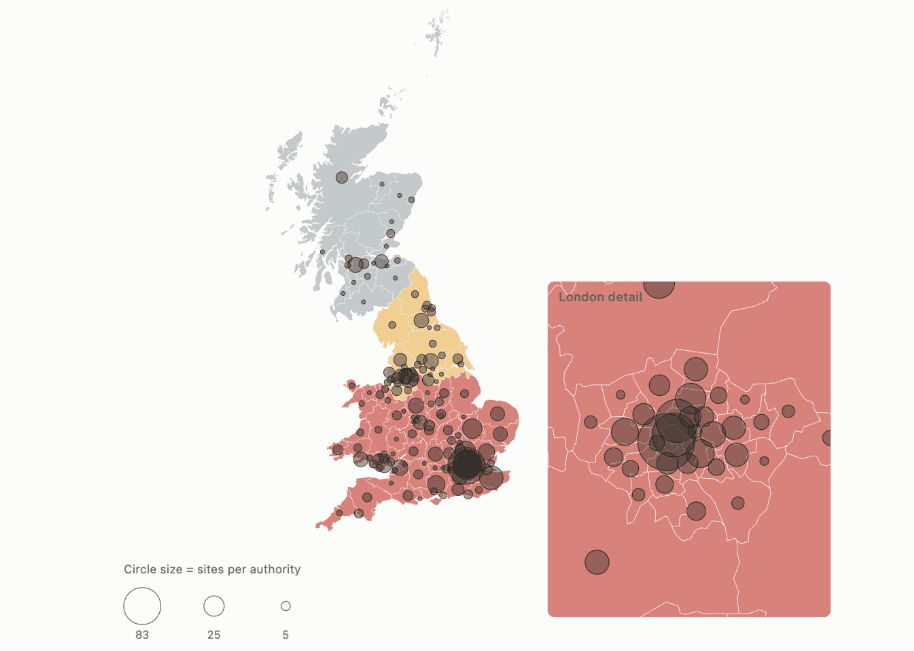
Shading is by local authority, assigned from its Environment Agency, NRW or SEPA area. Circles sit at authority centroids and show site counts, not exact site locations. Northern Ireland is out of scope and unshaded.
The areas of Britain most severely affected by environmental challenges align closely with high-density residential growth hubs. Notably, the South East has emerged as the nation’s most parched region. August rainfall reached just 5% of its typical volume, compared to the 17% national average. Kent, which currently has 34 live new-build sites, has seen the lowest rainfall this year, with just 1mm across the whole of July.
9 water companies, including Thames Water, Affinity and Southern Water, have all implemented and extended their water bans. This means people in the south could face a £1,000 fine if reported for using a hosepipe for domestic uses, such as watering their garden or cleaning their car.
Even with its reputation for heavy rainfall, Wales has officially entered drought status nationwide, matching the strict water conservation measures implemented across England. BuildSafe data indicates that 34 residential development sites are currently active within the country. England and Wales equate to 82% of new-build sites operating in drought areas.
What does this mean for housebuilders?
Commercial Director, Alex Lyons at BuildSafe, who specialises in insurance for housebuilders across the UK, says developers are working against numerous obstacles to try and meet ambitious targets set by the government. The current target to build 1.5million homes by 2029 is set against a landscape of increasing materials costs affected by the current war in Ukraine, a decline in land buying and drastic climate change:
‘Today, housebuilders have to understand the current climate they operate in is not going to go away and therefore have to plan for a world with more restrictions, harsher climates and tougher regulation to not only thrive but survive in a challenging industry.
There are not only hurdles to tackle during development but also the sustainability of the homes for the future. This means that restrictions on supplies affect construction quality and create future defect risks such as the quality of recycled water, programme delays, changing materials or construction methods, or foundation design.”
What do housebuilders need to prepare for the future:
In today’s climate, housebuilders now need to design for water scarcity, ground movement and extreme weather, while ensuring developments remain insurable and warranty-compliant, as well as using water sustainably and smartly:
Initial site assessments
In response to water scarcity, housebuilders must embed hydrological availability within their preliminary risk evaluations. This involves pinpointing regions under environmental stress and initiating early engagement with utility providers to establish infrastructure needs, ensuring financial and scheduling impacts are integrated into project planning.
Developers should prioritise standardised water-efficient fixtures, rainwater harvesting, and greywater recycling during the initial design phase to systematically reduce future demand.
Water-efficient homes
Reduce reliance on mains supply by integrating low-flow fixtures, dual-flush toilets, and water-efficient appliances.
Enhance performance through smart leak detection and consumption tracking, alongside site-wide rainwater harvesting and greywater recycling. Prioritise water-resilient architecture and drought-resistant landscaping during the design phase to ensure long-term sustainability.
Drought-resistant landscaping
Designing drought-resilient landscaping requires prioritising native, drought-tolerant species while minimising water-intensive lawns. Moisture retention strategies, such as appropriate soil preparation and mulching, should be combined with efficient irrigation systems like drip watering.
Additionally, developers should integrate rainwater harvesting, carefully consider tree placement to mitigate subsidence risks, and provide clear maintenance protocols to ensure green spaces remain viable during periods of water restriction.
Foundation and soil movement
Hotter and drier summers can cause clay soils to dry out and shrink, increasing the risk of ground movement and subsidence.
To manage the risks of ground movement and subsidence caused by dry weather, housebuilders must conduct thorough early soil investigations and design foundations accordingly.
It is essential to carefully manage drainage and vegetation, particularly in clay-prone areas, while monitoring ground conditions throughout construction to ensure long-term stability and insurance compliance.
Drought + flooding
Housebuilders should plan for the possibility of longer periods of drought followed by short, intense rainfall events. Developments should be designed to manage and retain water rather than simply drain it away:
To manage the transition between droughts and intense rainfall, developers should design sites that retain water rather than just draining it.This involves using Sustainable Drainage Systems (SuDS) like swales and ponds, incorporating permeable surfaces to boost infiltration, and installing rainwater harvesting systems.
By designing drainage systems to handle modern rainfall patterns rather than historic averages, and coordinating closely with local water authorities, developers can reduce flood risk, minimise runoff from compacted soils, and protect long-term insurability.
Construction disruption
Prolonged droughts and heatwaves threaten projects with delays, increased costs, and operational challenges. Housebuilders must mitigate these risks by proactively planning for water restrictions and groundworks disruptions.
Essential actions include early utility engagement, building robust contingency buffers into timelines and budgets, and maintaining detailed records of weather-related impacts.
Additionally, contractual and insurance reviews are vital to clarify liability and ensure ongoing project stability.
Review construction insurance
Housebuilders must proactively review insurance policies to mitigate risks from environmental factors such as droughts and ground movement. Ensure all-risks coverages explicitly include subsidence, heave, landslip, and provisions for business interruption or project delays.
Scrutinise policies for weather-related exclusions and confirm subcontractor coverage.
Early engagement with insurers is vital to identify potential gaps, alongside maintaining rigorous site records to establish liability should environmental disruptions occur.
Water scarcity is no longer an anomaly, but a critical design need. For housebuilders, the path forward demands a fundamental shift: moving away from reactive measures toward a proactive, climate-resilient approach. By embedding water-smart strategies into the bedrock of project design today, the industry can secure both project viability and long-term sustainability, turning the challenge of a drier climate into a standard for future-ready housing.